Unreal Animation Developer - Advanced Program

- Description
- Curriculum
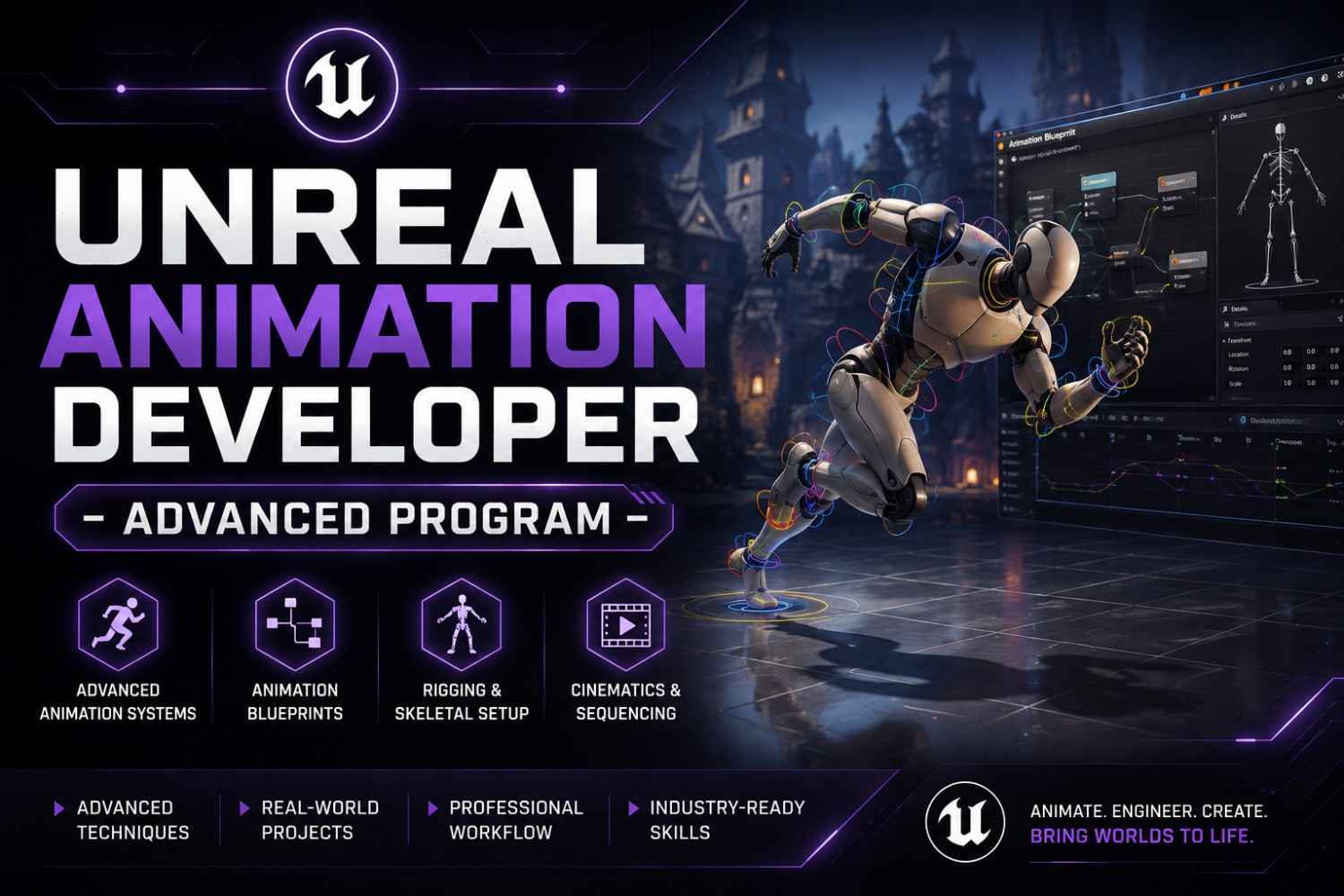
🚀🏆 Congratulations on Unlocking the Unreal Animation Developer – Advanced Program!
You’ve successfully completed the Unreal Animation Developer – Intermediate Program and unlocked the Unreal Animation Developer – Advanced Program! 🎉🔥
⚠ Note: If you have not completed our Intermediate Program, we assume that you already have a strong understanding of Unreal Engine animation systems, Animation Blueprints, State Machines, Blend Spaces, IK, locomotion systems, animation layering, montages, and gameplay-driven animation workflows before enrolling in this Advanced course.
Now it’s time to master professional animation pipelines, build highly polished and scalable animation systems, integrate complex gameplay mechanics with animation, optimize performance for production, and learn the advanced techniques used by AAA game studios. This program is designed to help you think like a professional Technical Animator and Gameplay Animation Developer while preparing you for real-world game production. Keep creating, keep refining, and move one step closer toward becoming an industry-ready Unreal Animation Developer! 💪🚀
🚀 Unreal Animation Developer – Advanced Program
Master the art of professional character animation with our Unreal Animation Developer – Advanced Program. This course is designed for developers, gameplay programmers, and technical animators who already possess a solid foundation in Unreal Engine animation systems and are ready to build complex, production-ready animation frameworks for modern games.
Throughout this advanced program, you will learn how to architect scalable animation systems, create responsive combat animations, develop advanced locomotion mechanics, integrate procedural animation techniques, optimize animation performance, and build animation-driven gameplay systems used in professional game development.
The course emphasizes modular workflows, maintainable animation architecture, multiplayer-ready animation systems, optimization strategies, and production best practices followed across the gaming industry. By the end of this program, you will have the knowledge and practical skills required to design sophisticated animation systems capable of supporting complex gameplay experiences in both single-player and multiplayer games.
🧠 Advanced Topics Covered
- Advanced Animation Architecture & System Design
- Modular Animation Frameworks
- Advanced State Machines & Transition Logic
- Complex Animation Blueprint Optimization
- Motion Warping & Dynamic Animation Adaptation
- Advanced Root Motion Techniques
- Procedural Animation Systems
- Full Body IK & Control Rig Integration
- Advanced Combat Animation Systems
- Layered Animation & Context-Based Blending
- Animation Events, Notifies & Gameplay Integration
- Dynamic Traversal & Parkour Animation Systems
- Advanced Character Interaction Animations
- Multiplayer Animation Replication & Synchronization
- Animation Debugging & Troubleshooting Techniques
- Animation Performance Profiling & Optimization
- Data-Driven Animation Workflows
- Animation Pipeline Best Practices
- AAA Production Workflow & Team Collaboration
- Professional Portfolio & Production-Ready Project Development
-
1
 What does the server own and what does the client own in a multiplayer animation system?
 -
2
What triggers animations correctly in multiplayer, and why must gameplay always come first?
-
3
What must replicate across the network and what should stay local in an animation system?
-
4
What is the correct multiplayer animation decision flow from input to visual?
-
5
 Assignment-01
-
6
What is the correct order of operations for a server-validated animation trigger, and why does order matter?
-
7
How do you prevent a client from triggering animations through cheating, and what makes an animation system 'cheat-resistant'?
-
8
What is the AnimNotify and AnimNotifyState, and what is the correct and incorrect use of each in multiplayer?
-
9
Assignment-02
-
18
How do you correctly synchronize hit reactions across all clients so they look right without requiring frame-perfect timing?
-
19
How do you handle hit reactions under high latency without breaking the visual experience?
-
20
How do death animations work in multiplayer, and what must the server ensure before the death animation plays?
-
21
Assignment-05
-
23
What are the most expensive operations in an Animation Blueprint, and where should they never appear?
-
24
What are Unreal's built-in Animation Update Rate Optimization (URO) settings, and how do they work?
-
25
What is the correct way to design event-driven animation variable updates instead of per-frame polling?
-
26
Assignment-07
-
27
What is the dirty-variable pattern and how does it eliminate redundant ABP Event Graph work?
-
28
What is caching in an ABP and what specific values should always be cached at initialization?
-
29
What are the Update Mode settings on a Skeletal Mesh Component and when should you use each?
-
30
Assignment-08
-
31
What is animation LOD and how does Unreal's built-in LOD system reduce animation cost at distance?
-
32
How do you set up distance-based behavior LOD in an ABP — not just mesh LOD, but animation logic LOD?
-
33
What is a crowd optimization strategy using shared animation and how do you implement it for AI groups?
-
34
Assignment-09
-
35
What is root motion, what does it cost, and when is it appropriate vs inappropriate?
-
36
Why is root motion dangerous in multiplayer and what is the safe alternative?
-
37
How do you implement a ladder or cover-entry animation with root motion while keeping multiplayer authority correct?
-
38
Assignment-10
-
43
What is the Animator → Tech Animator → Gameplay Programmer → QA pipeline, and what does each role own?
-
44
What are the animation asset handoff standards for importing animations from an external animator into Unreal Engine 5?
-
45
What is the variable contract between the Gameplay team and the Animation team, and why must it be written before implementation?
-
46
Assignment-13
-
47
How do you communicate animation system requirements to a gameplay programmer who has never worked with your ABP?
-
48
What are circular dependencies in an animation system and how do you design to avoid them?
-
49
How do you correctly hand off an animation system for quality review, and what does a good review submission look like?
-
50
Assignment-14
-
51
What is state lock in an Animation Blueprint, what causes it, and how do you diagnose and fix it?
-
52
What are transition dead-ends and how do you systematically prevent them in a state machine?
-
53
What causes AnimNotify timing bugs, how do they manifest, and how do you diagnose and fix them precisely?
-
54
Assignment-15
-
58
What is the correct mindset and process for receiving animation review feedback?
-
59
How do you iterate on an animation system safely without breaking previously approved behavior?
-
60
What makes a good iteration cycle, and what does a professional iteration workflow look like from feedback to sign-off?
-
61
Assignment-17
-
63
What is edge-case testing for animation systems and what specific edge cases must every animation developer test?
-
64
What is interrupt resilience in an animation system and how do you verify that the system always recovers to a safe state?
-
65
What is an animation deadlock and how does the timeout fallback prevent it permanently?
-
66
Assignment-19
-
67
What is the correct priority hierarchy when visual quality and gameplay responsiveness conflict?
-
68
How do you correctly polish combat animations without introducing latency, state machine issues, or multiplayer bugs?
-
69
How do you polish AI animations differently from player character animations, and what AI polish is always worth doing?
-
70
Assignment-20
-
71
What is a production lock and what types of changes are always safe late in a project?
-
72
What changes must never be made near release, and why does the blast radius rule determine this?
-
73
How do you defend a production lock decision when a stakeholder insists on a last-minute change?
-
74
Assignment-21